Physical strength is an important part of a healthy and active lifestyle. Strong muscles help you perform everyday activities with greater ease, improve body stability, support good posture, and make physical activities more enjoyable. Whether you are a beginner or already exercise regularly, choosing the right strength exercises can help you build stronger muscles and improve overall fitness.
The best exercises for improving physical strength usually involve several muscle groups and allow you to gradually increase the challenge. You do not always need expensive gym equipment to become stronger. Many effective strength exercises can be performed at home using your body weight, while others can be done with dumbbells, resistance bands, or basic gym equipment.
Why Physical Strength Is Important
Physical strength is more than having large muscles. Strong muscles help support your bones and joints while making daily movements easier. Carrying groceries, climbing stairs, lifting objects, walking for long periods, and maintaining balance can all become easier when your muscles are strong.
Strength training can also improve muscular endurance and body control. Regular exercise may help you maintain a healthy body composition and support your ability to stay active as you get older. The key is to choose exercises that train different areas of the body and perform them with proper technique.
Squats for Lower Body Strength
Squats are one of the best exercises for improving physical strength because they work several muscles at the same time. They mainly target the thighs, hips, and glutes while also engaging the core.
To perform a basic squat, stand with your feet about shoulder width apart. Keep your chest comfortable and your back in a natural position. Bend your knees and push your hips backward as if you are sitting on a chair. Lower your body as far as you can while maintaining good form, then push through your feet to return to the starting position.
Beginners can start with bodyweight squats. As strength improves, you can add resistance with dumbbells or other suitable weights.
Push Ups for Upper Body Strength
Push ups are a simple and effective exercise for developing upper body strength. They work the chest, shoulders, arms, and core.
Start in a plank position with your hands placed slightly wider than your shoulders. Keep your body in a straight line and slowly lower your chest toward the floor. Push through your hands to return to the starting position.
If regular push ups are difficult, beginners can start with an easier variation such as performing them against a wall or elevated surface. Gradually working toward standard push ups can help improve strength over time.
Lunges for Leg Strength and Balance
Lunges are another excellent exercise for improving lower body strength. They work the legs and glutes while also challenging balance and coordination.
Stand upright and take a comfortable step forward with one foot. Bend both knees while lowering your body toward the floor. Keep your front knee controlled and avoid allowing it to collapse inward. Push through the front foot to return to the standing position.
You can perform alternating lunges or complete several repetitions on one side before changing sides. Once the movement becomes comfortable, you can hold light weights to increase resistance.
Planks for Core Strength
A strong core provides stability for many other exercises and everyday movements. Planks are among the most useful exercises for strengthening the core without equipment.
To perform a basic plank, place your forearms on the floor and extend your legs behind you. Keep your body in a straight line from your shoulders toward your feet. Tighten your abdominal muscles and hold the position while breathing normally.
Beginners should focus on maintaining proper form rather than holding the plank for a very long time. As your core becomes stronger, you can gradually increase the duration.
Deadlifts for Full Body Strength
Deadlifts are a powerful strength exercise that can train the lower back, glutes, hamstrings, and other muscles involved in lifting movements. They can be performed with dumbbells, barbells, or other appropriate resistance.
Start with a light weight while learning the movement. Keep your back in a neutral position and bend through your hips while lowering the weight. Keep the resistance close to your body and use your legs and hips to return to a standing position.
Because technique is especially important during deadlifts, beginners should learn the movement carefully before increasing the amount of weight.
Rows for Back and Arm Strength
Rows are useful for strengthening the upper back and arms. They can help balance exercises such as push ups, which focus more on the front of the upper body.
A dumbbell row can be performed by placing one hand on a stable surface while holding a dumbbell in the other hand. Pull the weight toward your body while keeping your elbow controlled. Slowly lower it back down and repeat.
Resistance bands can also be used for rows, making this exercise suitable for home workouts.
Shoulder Press for Upper Body Strength
The shoulder press focuses on the shoulders and arms while also requiring control from the core. You can perform it with dumbbells or resistance bands.
Start with the weights around shoulder level. Press them upward until your arms are comfortably extended, then slowly lower them back to the starting position.
Choose a resistance level that allows you to maintain proper technique. Increasing weight too quickly can make it harder to control the movement.
Glute Bridges for Hip Strength
Glute bridges are simple but effective for strengthening the glutes and supporting muscles around the hips.
Lie on your back with your knees bent and your feet placed firmly on the floor. Keep your arms relaxed beside your body. Press through your feet and lift your hips upward while squeezing your glutes. Pause briefly at the top and then lower your hips with control.
This exercise is useful for beginners because it does not require equipment and can easily be included in a home workout routine.
Pull Ups for Upper Body Strength
Pull ups are one of the more challenging exercises for developing upper body strength. They mainly work the back and arms while requiring significant core control.
Hold a secure pull up bar with your hands and pull your body upward while keeping the movement controlled. Lower yourself slowly to complete the repetition.
If you cannot perform a full pull up yet, you can begin with assisted variations or other pulling exercises. Building strength gradually can help you work toward performing full repetitions.
Step Ups for Leg Strength
Step ups are a practical exercise that targets the legs and glutes while also challenging balance. You need a stable platform that is appropriate for exercise.
Place one foot on the platform and push through that leg to bring your body upward. Step down carefully and repeat on the other side.
Start with a low platform and focus on controlled movement. You can increase the challenge later by holding light weights.
How Often Should You Do Strength Exercises?
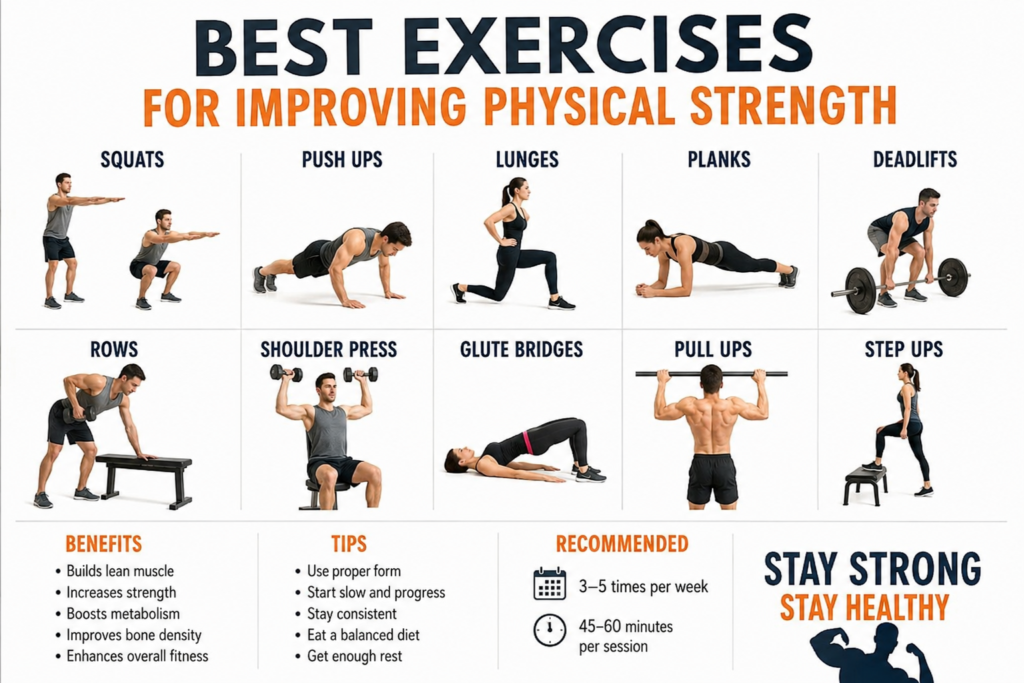
For general fitness, many people can benefit from strength training several times each week. Beginners should give their muscles enough time to recover between challenging workouts.
A simple routine can include exercises for the legs, upper body, and core. You can begin with two or three strength sessions each week and adjust your routine as your fitness level improves.
Recovery is an important part of building physical strength. Your body needs adequate rest, food, hydration, and sleep to support adaptation after exercise.
How to Improve Strength Over Time
Progressive overload is one of the most important principles for improving physical strength. This means gradually making an exercise more challenging as your body adapts.
You can increase resistance, perform additional repetitions, add another set, improve your range of motion, or make the movement more controlled. You do not need to increase everything at once.
Good technique should always come before heavier resistance. Performing an exercise correctly helps you train the intended muscles and reduces unnecessary strain.
Common Mistakes to Avoid
One common mistake is trying to lift too much weight too soon. Strength develops gradually, so rushing the process can make exercises harder to perform correctly.
Another mistake is skipping the warm up. A few minutes of light movement can prepare your body for exercise. It is also important to avoid training the same muscles intensely every day without allowing adequate recovery.
Finally, avoid focusing on only one muscle group. A balanced strength workout should include movements that train the legs, hips, back, chest, shoulders, arms, and core.
Final Thoughts
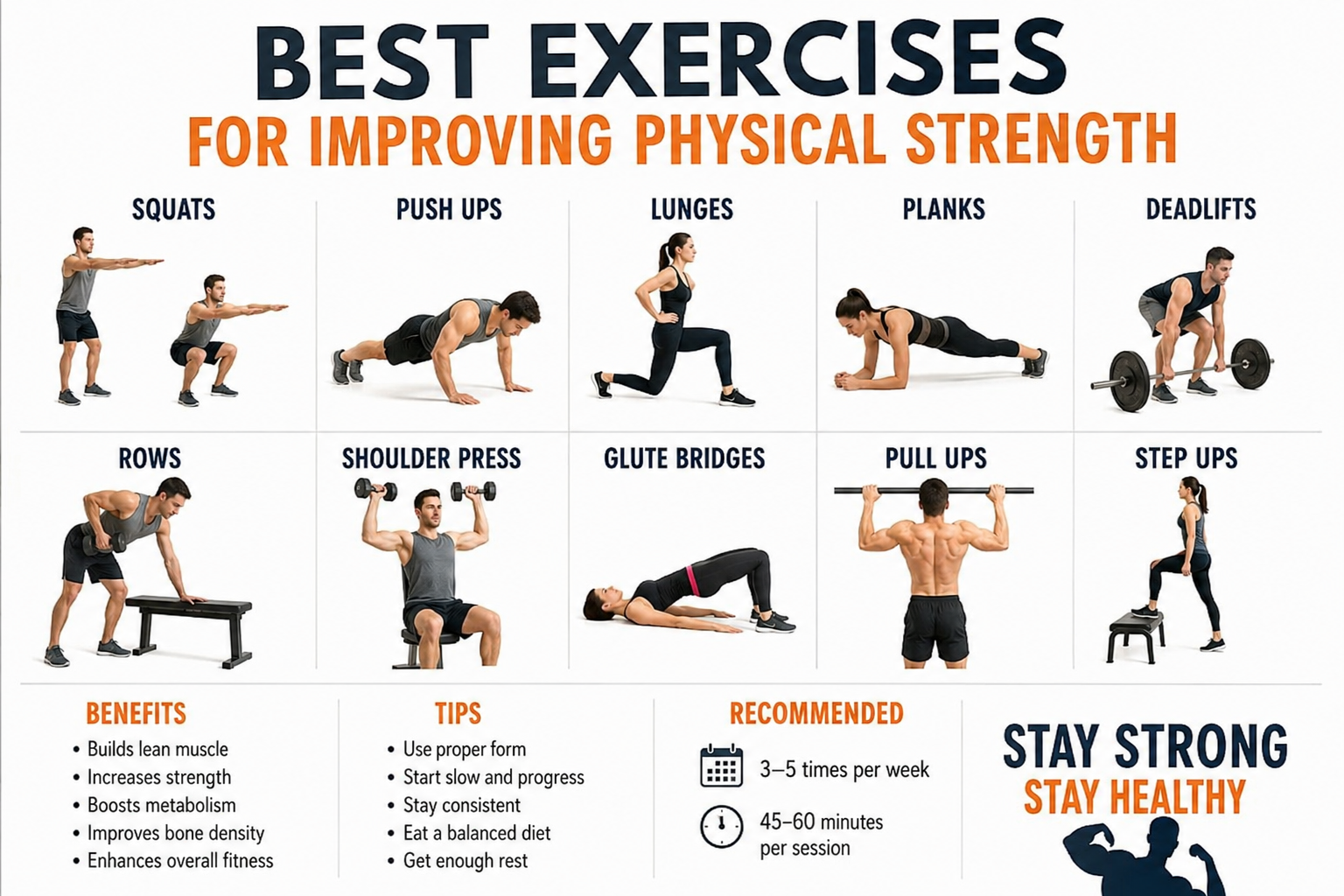
The best exercises for improving physical strength are not necessarily the most complicated ones. Squats, push ups, lunges, planks, deadlifts, rows, shoulder presses, glute bridges, pull ups, and step ups can provide an effective foundation for a strong body.
Start at a level that matches your current fitness ability and focus on proper technique. As your muscles become stronger, gradually increase the challenge. With consistency, patience, good recovery, and a balanced exercise routine, you can make steady progress toward better physical strength and overall fitness.